I’ve been looking around for some fresh post-rock instrumental music for a while now, but I keep going back to my old favourites. That was until today when I stumbled across a great little Facebook group that helps to point us all in the right direction.
Barely two scrolls into my new favourite page, I came across an absolute gem from Vasudeva, a New Jersey band that this year released new album with an opening song, Take Away, that absolutely blew my mind.
There is so much to love about this tune. It’s cheery opening, bouncy demeanour, and absolutely epic middle section, essentially half the song and featuring some grotesquely fabulous drumming. And then there’s the charming little audio sample at the very end, which I won’t spoil for you. Just take a listen.
What’s great about Vasudeva — and I don’t know if this has always been the case because I’ve only just got to know them — is the brightness in their music. Post-rock is an emotional experience, and while it’s often triumphant and swells your heart to bursting, it can also take on a very sombre feel at times. This, though, is different. It’s got a definite air of positivity about it, and if you could headbang in your yoga class, this would be the perfect soundtrack.
I’m off to get stuck into the rest of this album, and I reckon you should too. It’s called No Clearance.
If you thought Sinead O’Connor’s cover of Prince’s Nothing Compares 2 U was the best, think again. Nikka Costa — the ridiculously sexy, soulful and talented American singer — has just put out her version, and it’s pretty spectacular.
The single release is the prelude to the 44-year-old’s new album, which has been recorded with nothing more than a rhythm section, a string quartet and a few backing singers. If this track is anything to go by, the rest of the album will be an outstanding experience.
Upon announcing the project — a partnership with Pledge Music — Nikka said: “I’m switching gears a bit for a new album and am really excited to be recording with a rhythm section and a string quartet. I have some songs I’ve always wanted to record with this line-up and make into a very special album featuring this music I love.”
The album won’t be all covers, though. There will also be “some standards, some unexpected covers and some of my own new material, written especially for this project”.
“I’m so excited,” Nikka said. We are, too.
And get this: she recorded the whole thing in ONE DAY!!
There are many goose-bump moments on this first release. No doubt we’ll look like freshly plucked chickens upon hearing the rest of it.
Recently I stumbled across a YouTube channel that has taken remixing to a whole new level.
TRONICBOX picks all your favourite tunes from the present day, or very recent past, and reworks them into nostalgic Eighties hits, and quite frankly, they’re superb.
My first encounter with TRONICBOX, who hails from Canada and describes himself — or herself, who knows? — as “a musician, gamer, and software developer from Saskatchewan Canada”, was when a version of Gotye’s Somebody That I Used To Know popped up on one of my many online feeds. Take a listen.
Instantly it threw me back to my youth. Everything about it made me smile, from the hilarious cover shot to the production itself, replete with punchy disco drum sounds, the most kitsch electric piano you can imagine and the type of pulsing electro bassline every Eighties kid bounced to back in the day. Add to that wailing guitar solos you might hear in a Rocky training montage, and what you’ve got is a pretty perfect work of art.
The original — a duet with Kimbra — was, of course, a massive hit in its own right, and the genius of this remix wasn’t lost on Kimbra herself when she posted this to her Facebook page.
When I heard TRONICBOX’s equally magnificent rejig of Lady Gaga’s Bad Romance, I had to share this stuff with the world. This time, it’s not just the tune that will give you happy little goosebumps, but the video as well. Having been a fitness instructor in my deep, dark past, I could relate even more. It’s also a lot rockier, which I like. This is Europe meets early Bon Jovi with a bit of Journey tossed in for good measure. Impossibly good.
The remixes keep coming, which is good news. Katy Perry has been morphed into a Jane Fonda for her remix, while her hit Firework is transformed into a disco funk number Chaka Khan would have been proud to perform in her heyday.
Whoever TRONICBOX is, I hope he/she sees this. Please say hi, and keep us posted on what’s coming next because so far, I’m blown away by your skills. Thank you, from the bottom of my nostalgic heart. This stuff is just too good to be true.
Here’s a cheesy version of Justin Bieber’s Baby to sign off. The sax solo is magnificent! And that pic!! 🤣
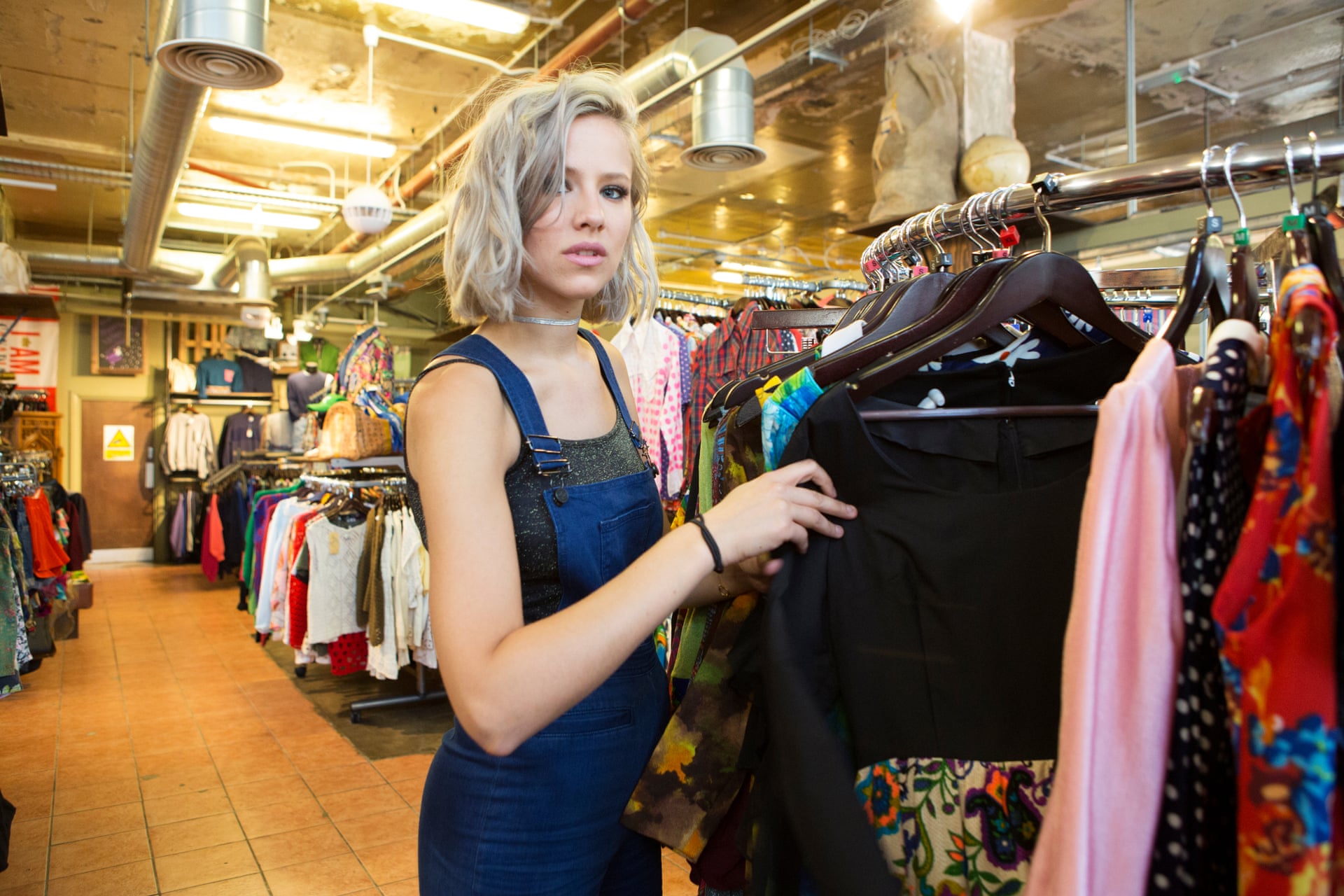
Dagny out shopping in London | Richard Saker / The Guardian
I’ve been following Dagny’s fledgling career for a little more than year now, and I’m so thrilled she’s finally getting some solid recognition in her native Norway as we settle into a new year.
Last year saw the release of a debut EP, Ultrviolet, which featured five absolutely cracking pop tunes, each with their own aesthetic but perfectly poised as a collection. It appears, though, we’re lucky to hear them at all, given she almost gave up her music dream the previous year.
Thankfully her parents — both musicians, which isn’t unusual in her hometown of Trømso — talked her into persevering, and now here we are in 2017 with many musical columnists and bloggers listing Dagny their “ones to watch” lists.
The song many of you may have heard is Backbeat, which essentially gave her a boost after Zane Lowe premiered it on Beats 1 — Apple Music’s radio station — before it had even been mastered. From there it was soon in demand, and racking up the plays on Spotify. It’s closing in on 25 million plays at the time of writing, and sounds pretty magnificent in this live discvr session for Vevo.
In a sense, this is a pop tune from the old school, devoid of overly produced synthetic elements and comprised of real instruments played by real musicians and produced faithfully. But the EP does contain more traditional pop tunes, Too Young the most obvious of these with a pulsing chorus that hints at early Katy Perry in parts, only 10 million times better. Even beneath the heavy synth pads, though, there remains those subtle guitar parts and bombastic rhythms that truly characterise Dagny’s sound, and paint a classy indie varnish on her already sparkling songs.
As a drummer, I’m obsessed with some of the parts on the EP, not least the track Fool’s Gold, my personal favourite. Here’s a live cut of it from NRK’s P3 Gull music show, featuring a nice little cameo from Kristian Kristensen — BØRNS does the recorded version — and drummer Harry Mead doing the business on the skins.
Man, I wish we had shows like this in Australia, but I digress.
Dagny has been through a lot for her young years. She’ll turn 27 this year, but has already had to deal with her older brother being diagnosed with cancer when he was 15 and she was just nine. It’s tough life experiences like this that are often the inspiration for many of the best artists, and I hope Dagny is on her way to being one.
Vocally she’s certainly got something unique. She speaks in somewhat crackled, husky tones, and that comes through in her singing, but she holds exceptional clarity in the higher registers, and finds some seriously catchy melodies to carry her often melancholic storylines.
With flawless Norwegian good looks to boot, you could call Dagny the perfect package. It remains to be seen if the often narrow-minded talent spotters outside Norway realise it and give her the big break she truly deserves.
So what did you think of Lady Gaga’s half-time show at Superbowl LI? Personally, I thought it was magnificent.
Predictably I got some smart-arse comments on the post, a couple of laughs, but that’s OK. After all, we all have different tastes, and one of the many things Gaga encourages us to celebrate is our diversity. So laugh it up. I couldn’t care less.
Here’s what I posted.
“Anyone that thinks Lady Gaga’s half-time show wasn’t political has either got their head stuck up their arse, or simply doesn’t understand her genius.”
I wasn’t looking for likes or laughs, to be honest. My sentiment was largely in response to a tweet a old colleague of mine had shared on Twitter — presumably in its support — which suggested Gaga had no message in 2017, and that Beyonce’s less subtle effort of 2016 was braver and more meaningful.
I took issue with this. To me, Gaga’s performance packed with political rhetoric, and was flawless in its execution. Here’s why.
The opening
Atop the NRG Stadium, and backed by 300 drones that lit up and hovered miraculously to create the United States’ flag, Gaga sang excerpts from two of America’s most patriotic songs, starting with God Bless America before rolling seamlessly into This Land Is Your Land. She then quoted from the The Pledge Of Allegiance before theatrically diving into the packed arena. What’s so cool about that? Well, it’s no secret that America is more divided than ever right now. What brings Americans together more than anything? Usually patriotic tunes and the star-spangled banner, and a reminder that despite what some people might say, there is a lot to celebrate about the country. It just needs to be focused on a little more.
The first songs
After belting out a small segment of Poker Face — pausing after the first-line reference to Texas as a nod of respect to the Houston location — Gaga moved into her anthem for those on the peripheral, Born This Way. If that wasn’t a middle finger to all the bigots, racists, homophobes and so on that have crawled out of their holes to celebrate the more extreme messages being bandied about by Donald Trump and others, I don’t know what is.
“No matter gay, straight, or bi / Lesbian, transgendered life / I’m on the right track baby/ I was born to survive,” she roared.
“No matter black, white or beige / Chola or orient made / I’m on the right track baby / I was born to be brave.”
Magnificent.
From middle to end
After Telephone, which didn’t feature an appearance from Beyonce as some had predicted, Gaga went into positivity mode with Just Dance. “We’re here to make you feel good,” she said after that one. “You wanna feel good with us?”
Looks like the pundits who said she’d been warned off politics were also brilliantly mis-informed.
Million Reasons was the penultimate number, a song all about searching out the best in everything and of course featuring the line “If you say something that you might even mean, it’s hard to even fathom which parts I should believe.” Fake news, anyone? Just superb.
Now I can’t be sure that Gaga’s chosen closer, Bad Romance, was in any way a reference to Trump and his wife Melania’s relationship — I like to think it maybe was — but by this point she was decked out in gridiron shoulder-pads, ready to do battle with any shit the world can throw at her, or any of her little monsters — the term she uses lovingly for her millions of fans.
I’m lucky enough to have seen Lady Gaga live, and I maintain it was one of the best shows I’ve ever witnessed. If you were to look at my musical tastes generally, she is not someone you’d expect me to pay money to see, but it’s her ability to bring social issues to the forefront without aggression or animosity that I admire most.
I remember that night in Sydney, before playing Gypsy, she delivered an impassioned speech to the many LGBTQ members of the audience, showering them with love and the belief that they matter. It was as touching a moment as I’ve ever seen at a musical performance, and trust me, grown adults were crying by the time she finished, and I wasn’t far off it myself. She then massively uplifted us all with the joy of the song Gypsy, which celebrates a world in union. That was the one big track I felt she could have also thrown in at the Superbowl.
But I’m being picky now. My love for Gaga has only grown more as a result of her half-time heroics, and I’m more than happy to put my paws up and scream it from the rooftop of any stadium you want to place me on. Gaga rules, end of story.
It’s been close to four years since we heard anything new from Goldfrapp, but they’re back in 2017 with a hot new single, Anymore, and plans to release their first new album since 2013.
That album’s name is Silver Eye, and if you’re keen as a bean to get your hands on it, you can pre-order it via this link. If Anymore is anything to go by, it’ll be equally as awesome as all previous six albums the duo has released. As the new song repeats in its catchy chorus, “I can’t wait anymore”.
About a month ago, Alison Goldfrapp and Will Gregory, who make up the duo, posted a pic to a new Instagram account with nothing more than the hashtag #goldfrapp7, alluding to the seventh album, which has since been confirmed. It was thought that pic was a reference to the album artwork, given it followed six previous posts featuring the artwork of their previous six albums.
There had been rumours the new record might be more organic than the electronically-laden sounds of previous records, based on comments made by Goldfrapp a while back, and also because of what had been produced for the band’s 2013 album Tales Of Us, which is heavy on strings and acoustic guitars. Having said that, so to was the 2000 debut album Felt Machine, but with more trip-hop tendencies that were so de rigueur of the time.
But Anymore appears to put that theory well and truly to bed. While it’s not as rich and heavy on synths as the likes of Ooh La La or Strict Machine, it is a bouncy little electro number that evokes memories of Train from the 2003 album Black Cherry. It’s got a catchy chorus, Goldfrapp’s signature breathy vocals, and the hypnotic beats that are so characteristic of the London pair’s biggest hits.
Expect to hear this one a lot in the coming months as the countdown to the album release ticks down. The first live airing of these new tunes — the album listing is beliw — will be at the end of March when Goldfrapp plays a pre-release show at the London Roundhouse. If you’re lucky enough to be there, it should be a pretty fun night.
Silver Eye Track List
Anymore Systemagic Tigerman Become The One Faux Suede Drifter Zodiac Black Beast That Never Was Everything Is Never Enough Moon in Your Mouth Ocean
When I first discovered Emilie Nicolas, I was blown away. That was almost three years ago now, and I can’t believe where the time has gone. The good news is she’s back with a new single, Sky, and it’s every bit as wonderful as her previous work.
Nicolas has one of those ethereal Norwegian voices that I just can’t live without. The work she put in on her debut album, Like I’m A Warrior, was superb. I was only able to get hold of it through a friend in Oslo, who sent me the CD. I just wish her managers would expose her to a wider audience, because she’s got such a wonderful talent, it deserves to be heard far and wide. Very little is available to listen to in Australia, which sucks big time for those without contacts in Norway.
However, 2016 sounds like it was a rough one for the young songstress. After the success of that debut album, driven in part by her brilliant cover of Pstereo, she was forced to go into hiding somewhat and cancel a bunch of shows because of illness.
According to her Facebook page, she’s slowly getting better and can’t wait to get back into the swing of things in 2017. We wish her a speedy recovery and look forward to seeing her back on stage fitter and stronger and with new material to obsess over.
Then along comes the end of 2016, beginning of 2017, and this young lady melts our brains again with a performance so intense and beautiful, there are no words to describe it. Just listen to this live version of the band’s newest track, Rooting For You, and try not to get goosebumps — or even weep a little.
The studio version of this track doesn’t feature to vocal solo you see in this clip, which dilutes its effect somewhat. Nevertheless, it’s encouraging to know the band has lost none of its creativity in the years since releasing its last recordings in 2013.
Hands up if you’re looking forward to more of this!! We certainly are.
Hello again! Yes, it’s been a while, and we’ve got a lot to catch up on. I’ve been a bit busy with work, establishing myself as a freelancer, and it’s all been going well. But not, with the year turned over, I’m ready to get back into posting my musical discoveries here, so I hope you’ll stay for the ride, and apologies to those of you that do follow me for being so quiet these past few months.
So I thought I’d start with a bang — a big one — and share this show by British post-rock outfit Maybeshewill.
Those of you that have been here before will know I’ve got a bit of an obsession with post-rock, and these guys have been at the forefront of that for about a decade. Sadly 2016 was the band’s last after it announced it would disband in 2015. I’m particularly gutted about this as I never managed to see the boys live, but this last show — played at London’s terrific Koko venue — is as good a substitute as I’ll get. It’s brilliant, and be sure to play it loud.
If you’d like to download it and watch it over and over again — and there is no maybe about whether or not I will do so — you can grab it from this link.
I’ll be back with more soon, and will commit to post at least once a week. Don’t forget to follow the Light + Shade Facebook page here, as all our posts go there, along with a few other random things.

 Light+Shade